

The wood pellet industry maintains strong long-term growth potential. Global decarbonization policies and energy security demands drive steady market expansion. Short-term market fluctuations exist, but the overall upward trajectory remains stable through 2035.
The global wood pellet market reached USD 18.53 billion in 2026. Industry forecasts project it will hit USD 26 billion by 2031, with a steady CAGR of 7.01% during 2026–2031. This consistent growth proves wood pellets are no longer a niche biomass fuel, but a mainstream renewable energy solution.
Global Wood Pellet Market Demand by Region
Regional demand varies based on policy support and energy structure. Below is a clear breakdown of core consumption markets:
| Region | Market Status | Core Demand Features |
| Europe | Largest & most stable market | Strict renewable energy mandates; massive power generation and district heating demand; long-term import contracts |
| Asia-Pacific | Fastest-growing market | Japan and South Korea lead imports; industrial boiler co-firing dominates; rising year-on-year procurement volume |
| North America | Self-sufficient market | Focus on residential heating; sufficient local production; limited export surplus |
| Southeast Asia | Emerging production hub | Abundant raw materials; low production costs; mainly supplies Asian importers |
Key Growth Drivers for the Wood Pellet Industry
Four core factors support sustainable market growth in the next decade:
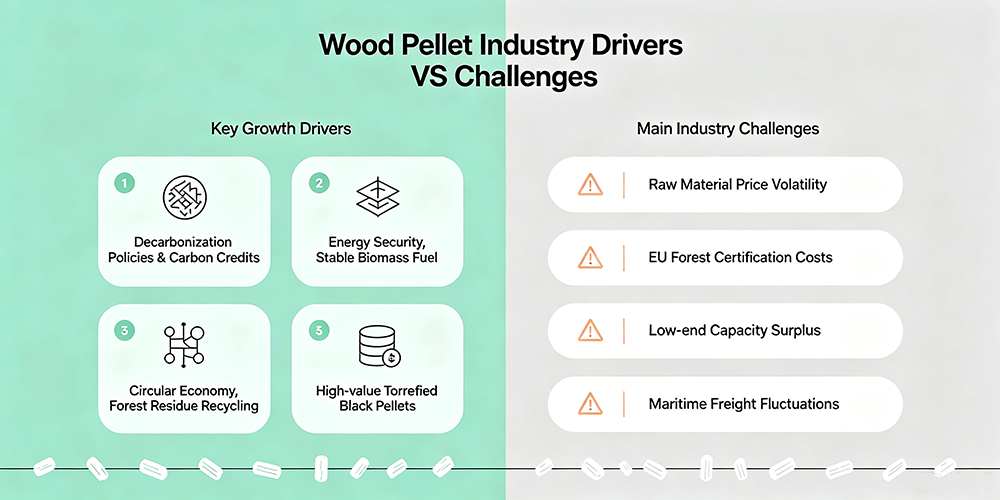
Strict global decarbonization policies: EU renewable directives and Asian carbon neutrality roadmaps force power plants to adopt biomass co-firing. Wood pellets help enterprises reduce carbon emissions and obtain tradable carbon credits.
Energy security needs: Fossil fuel prices remain volatile. Wood pellets are storable, transportable, and stable. They complement intermittent solar and wind power for reliable energy supply.
Circular economy advantages: Wood pellets use sawdust, wood scraps, and forest residues. They turn waste into clean energy and meet international environmental and sustainable development standards.
High-value product upgrading: Torrefied black pellets deliver higher calorific value and better moisture resistance. They suit long-distance shipping and large-scale power plant procurement with higher profit margins.
Main Industry Challenges
The wood pellet market faces controllable short-term challenges:
Raw material prices fluctuate seasonally, squeezing factory profit margins
Strict EU deforestation regulations increase export certification and traceability costs
Low-end overcapacity leads to vicious price competition
International shipping costs affect export profit stability
Future Wood Pellet Market Trends
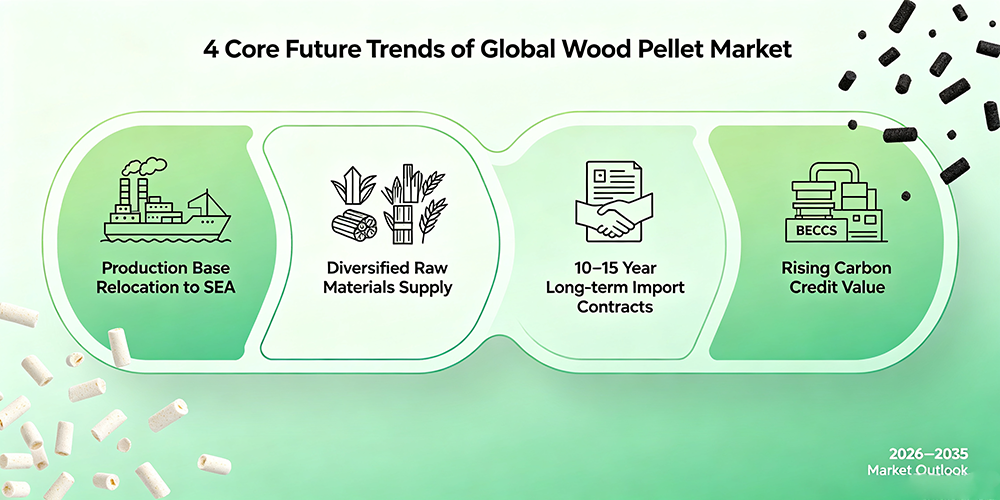
The industry will witness four clear development trends:
Production base relocation: Production capacity gradually shifts to Southeast Asia for low-cost raw materials and labor advantages.
Diversified raw materials: Manufacturers mix wood scraps, bamboo residues, and crop straws to stabilize supply and reduce costs.
Long-term contract dominance: Overseas buyers prefer 10–15 year fixed-price orders, stabilizing market sales volume.
Carbon value appreciation: BECCS carbon capture technology boosts the carbon credit value of wood pellets, bringing extra revenue for producers.
FAQ – Wood Pellet Future Market
Q1: Will new energy replace wood pellets in the future?
A: No. Solar and wind power are intermittent. Wood pellets provide stable base-load power and industrial heating. They complement rather than compete with new energy.
Q2: Which countries have the most stable wood pellet demand?
A: European countries including the UK and Netherlands, plus Japan and South Korea in Asia. These regions have policy-backed rigid demand with long-term procurement plans.
Q3: Which pellet type has better market prospects?
A: Torrefied black pellets lead the high-end export market. Standard white pellets suit local heating and short-distance trade. Both maintain stable market demand.
Final Conclusion
The wood pellet market holds solid long-term growth fundamentals. Policy decarbonization, energy security, and circular economy demands will continuously drive market expansion. Enterprises that stabilize raw material supply, complete international certifications, and deploy high-end pellet products will gain stable profits and long-term market dividends in the next decade.
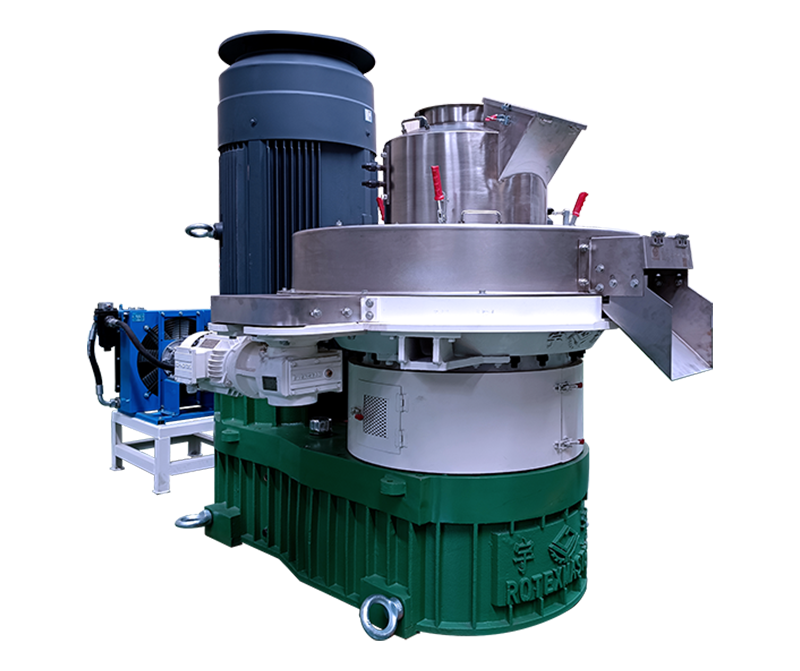
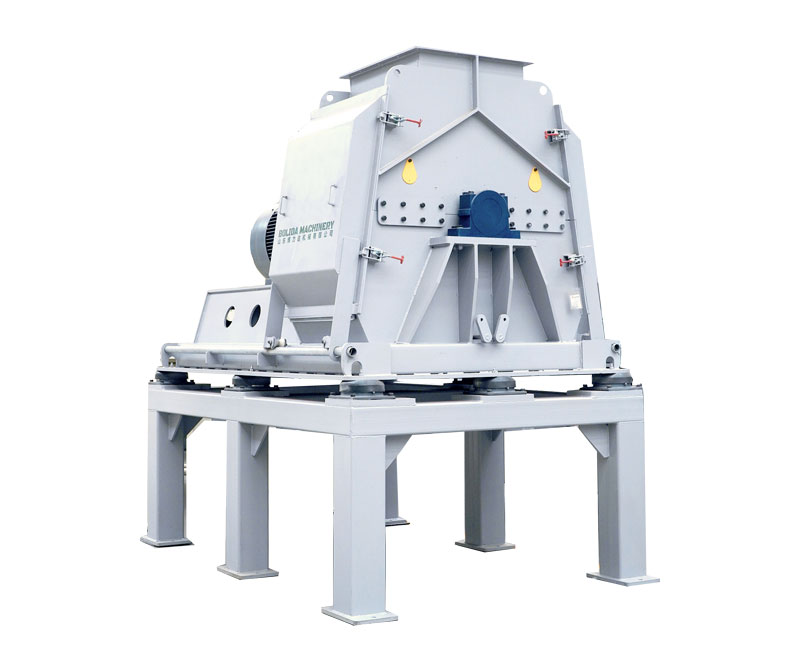
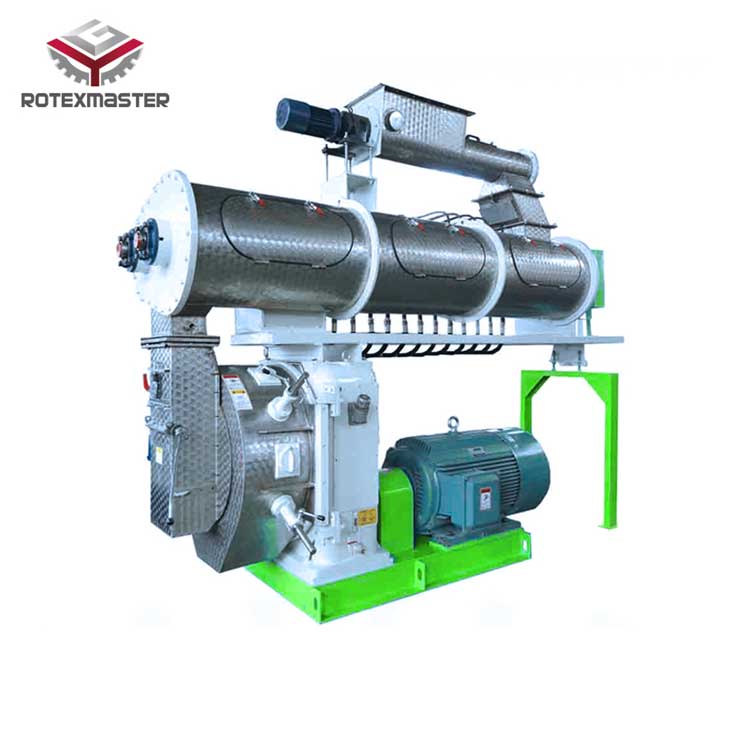
The Bolida & Rotexaster new vertical centrifugal pellet machine is the latest pellet machine in China. The pellet machine adopts a large modulus hard toothed helical gearbox, strengthened main shaft, strong power output, equipment stable operation, low failure rate, low production cost. It is the preferred machine model in the biomass industry.